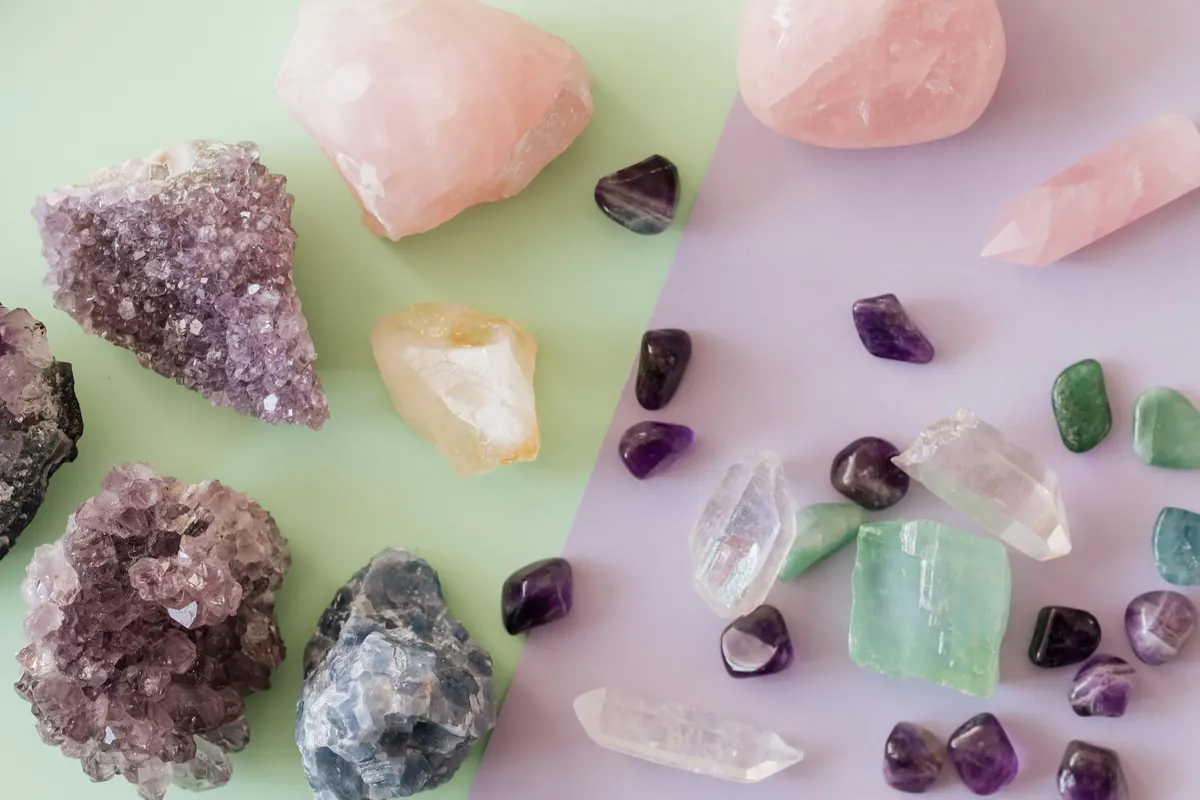
Put a pale, glassy crystal in front of most collectors and the first question is fair: quartz or calcite? The two share a colour range, a fondness for growing in cavities and veins, and a habit of turning up in the same rock. They also differ in ways you can test in the field with a knife, a hand lens and a small dropper bottle of acid — provided you know which test to trust, and in what order.
Quartz is silicon dioxide. Calcite is calcium carbonate. Nearly everything below follows from that single difference in chemistry.
Why the two get mixed up
Both minerals are colourless when pure, and both take on white, grey, honey, pink and brown tones depending on trace elements and inclusions. Both form in hydrothermal veins, both fill cavities in basalt and limestone, and both can be found in the same hand-sized specimen. Calcite is the main ingredient of limestone, chalk and marble, so it dominates whole landscapes; quartz dominates granite, sandstone and most beach sand.
Some of the confusion is commercial. Clear rhombohedra of Iceland spar sit in shop trays beside quartz points, and many so-called quartz geodes from limestone country turn out to be lined with calcite. If you have bought a bargain "quartz" cluster that looks oddly soft and pearly, there is a good chance you own calcite.
Hardness: your fastest test
On the Mohs scale, quartz is a 7 and calcite is a 3. That gap is enormous in practical terms, and it means a steel knife blade will scratch calcite easily but cannot touch quartz. A copper coin will also scratch calcite, while a fingernail will not.
Two cautions before you start scratching. First, test an inconspicuous corner or a broken edge, never a display face. Second, understand what a "scratch" looks like: dragging a steel point across quartz usually leaves a grey metal line that rubs away with a thumb. That is the knife losing, not the quartz. If the groove stays after you wipe it, the mineral is softer than the steel.
A thin calcite crust on a quartz crystal will fool you here too. Scrape the surface first and retest the clean material underneath.
The acid test, done sensibly
Calcite reacts with dilute acid because it is a carbonate. Even household vinegar will raise a few slow bubbles on a freshly broken surface or on powder, while dilute hydrochloric acid produces an immediate, vigorous fizz. Quartz does nothing at all. Dolomite, a common companion, reacts weakly and slowly, so judge the vigour rather than merely the presence of bubbles.
A single drop is enough. Use a dropper bottle rather than a dipping stick, work outdoors or beside an open window, and wear eye protection and gloves. Keep acid away from skin, clothing and metal tools, rinse the specimen and the work surface afterwards, and store the bottle clearly labelled and out of reach of children and pets. Test a fresh surface: weathered or polished faces often fail to react. And never acid-test a piece you care about, because it will dull a polished finish permanently.
Cleavage and the way they break
Calcite has three directions of perfect cleavage, and they meet at oblique angles. Break a lump and it comes apart into neat, slanted blocks — rhombohedra that look like squashed cubes. Cleavage faces are flat, often pearly, and repeat if you turn the fragment in the light.
Quartz has no cleavage at all. It fractures conchoidally, producing smooth curved surfaces with a shell-like pattern and a glassy sheen, much like the base of a chipped bottle. This is one of the most reliable differences between the two minerals, and it holds even when crystal shape is absent. Do not confuse a cleavage plane with a crystal face, either: crystal faces grow, cleavage planes split.
Crystal shape and habit
Well-formed quartz is unmistakable once you know it. Look for a six-sided prism topped by a pyramid, with fine horizontal striations running across the prism faces. Massive quartz, agate, chert and amethyst are the same mineral in less showy clothing.
Calcite is far more variable. It produces rhombohedra, sharp scalenohedra known as dog-tooth spar, flat nailhead crystals, prisms, fibres and granular masses, and it twins readily into heart and butterfly shapes. The giveaway is the angle: calcite rhombohedra lean, their faces meeting at something clearly other than 90 degrees, while quartz keeps its hexagonal symmetry.
Look-alike traps worth knowing
- Water-clear rhombohedra. Place the crystal over printed text. Calcite doubles the image; quartz does not.
- Dog-tooth calcite on amethyst. The purple is quartz and the white teeth are calcite. Test the part you actually mean.
- Coated quartz. A thin calcite skin fizzes while the core does not.
- "Quartz" geodes from limestone areas. Often calcite-lined, and they scratch too easily to be quartz.
A two-minute field routine
- Look first. Six-sided prisms with pyramid tips point to quartz; slanted blocks or dog teeth point to calcite.
- Check the surface with a 10x hand lens. Tilt the piece — calcite faces are often pearly and may show stepped cleavage lines.
- Hold any clear, pale piece over text to check for double refraction.
- Scratch a hidden corner with a steel point, then wipe. A mark that stays means a soft mineral.
- Add one drop of dilute acid to a fresh surface, watch the vigour of any fizz, then rinse thoroughly.
- Note the setting. Limestone, chalk and marble country favours calcite; granite, pegmatite and quartz veins favour quartz.
When a specimen is both, and what to do next
Many pieces are genuinely both minerals: quartz epimorphs after dissolved calcite, calcite perched on milky quartz, or quartz replacing calcite altogether. If a single test gives an ambiguous answer, run two on separate spots and write down which part reacted. Carry a hand lens, a steel point and a small labelled acid bottle in your bag, along with a soft brush for cleaning.
If a specimen is valuable, scientifically interesting or simply your favourite, put the knife away. Non-destructive checks — double refraction, fluorescence under a UV lamp, or a specific gravity measurement with proper equipment — will usually settle the question, and a local mineral club or museum can confirm an identification without leaving a mark. Whatever you conclude, label the specimen with the test result and the location while the details are fresh. In a year's time, that scribbled note will be the most useful thing in the drawer.